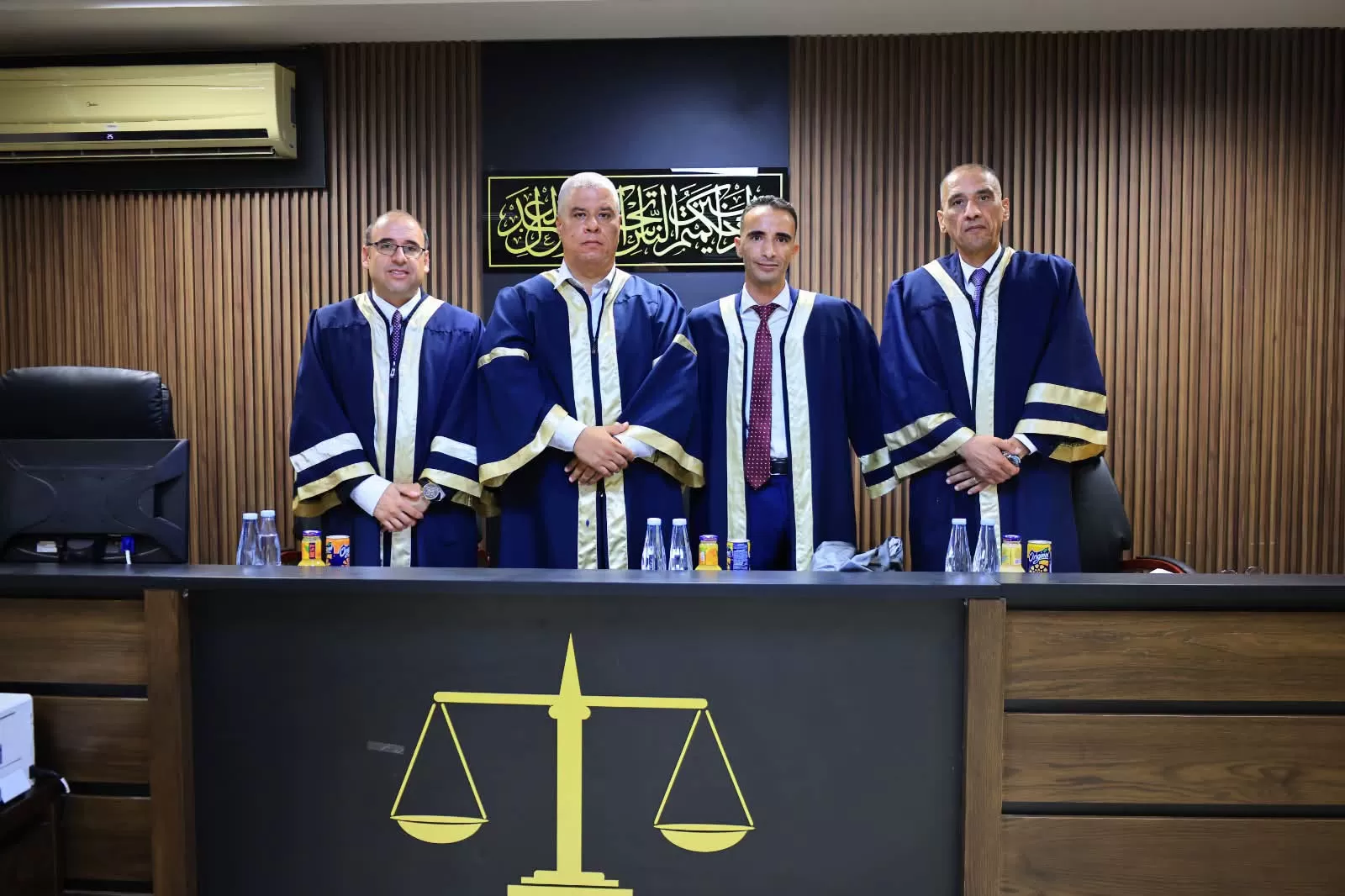
The Faculty of Graduate Studies and Scientific Research at Al-Istiqlal University, through the Department of Criminal Law, held the defense of a master’s thesis submitted by researcher Rafah Al-Awadat, entitled “Legal and Judicial Mechanisms for Holding Perpetrators of Israeli Crimes in the Gaza Strip Accountable.”
The examination committee comprised Dr. Mohammad Shalaldeh, Supervisor; Dr. Basil Rajoub, External Examiner; and Dr. Mohammad Shtayyeh, Internal Examiner.
The study sought to examine the legal and judicial mechanisms available for holding perpetrators of Israeli crimes in the Gaza Strip accountable and to assess their effectiveness in light of international public law, international humanitarian law, and international criminal law. Particular attention was given to the legal and judicial developments that followed the events of 7 October 2023.
The study addressed the central question of whether international and national legal and judicial mechanisms are sufficiently effective in ensuring accountability for crimes committed in the Gaza Strip, as well as the legal, political, and practical challenges affecting their implementation. To address this question, the researcher adopted descriptive-analytical and applied approaches, examining international legal provisions, judicial precedents, and resolutions adopted by international organizations and applying them to the Palestinian context.
The study concluded that, depending on the circumstances of each case, crimes committed in the Gaza Strip may fall within the categories of war crimes, crimes against humanity, and genocide, pursuant to the provisions of the Rome Statute and other relevant rules of international law.
The study further indicated that the International Criminal Court constitutes one of the principal criminal justice mechanisms for holding individuals accountable for international crimes on the basis of individual criminal responsibility. Meanwhile, the International Court of Justice, together with other international and regional mechanisms, contributes to advancing accountability by affirming the international responsibility of states and strengthening respect for and protection of the principles of international law.
The study concluded that effective accountability requires complementary roles for international and national judicial systems, stronger international cooperation in fulfilling legal obligations, and sustained support for efforts to document crimes and preserve evidence. Such measures are essential to combating impunity, providing justice and redress for victims, and upholding the principles of international justice and the rule of law.
At the conclusion of the defense, the examination committee declared the researcher successful, following confirmation that the thesis had fulfilled the required academic and research standards, subject to the completion of the requested revisions.