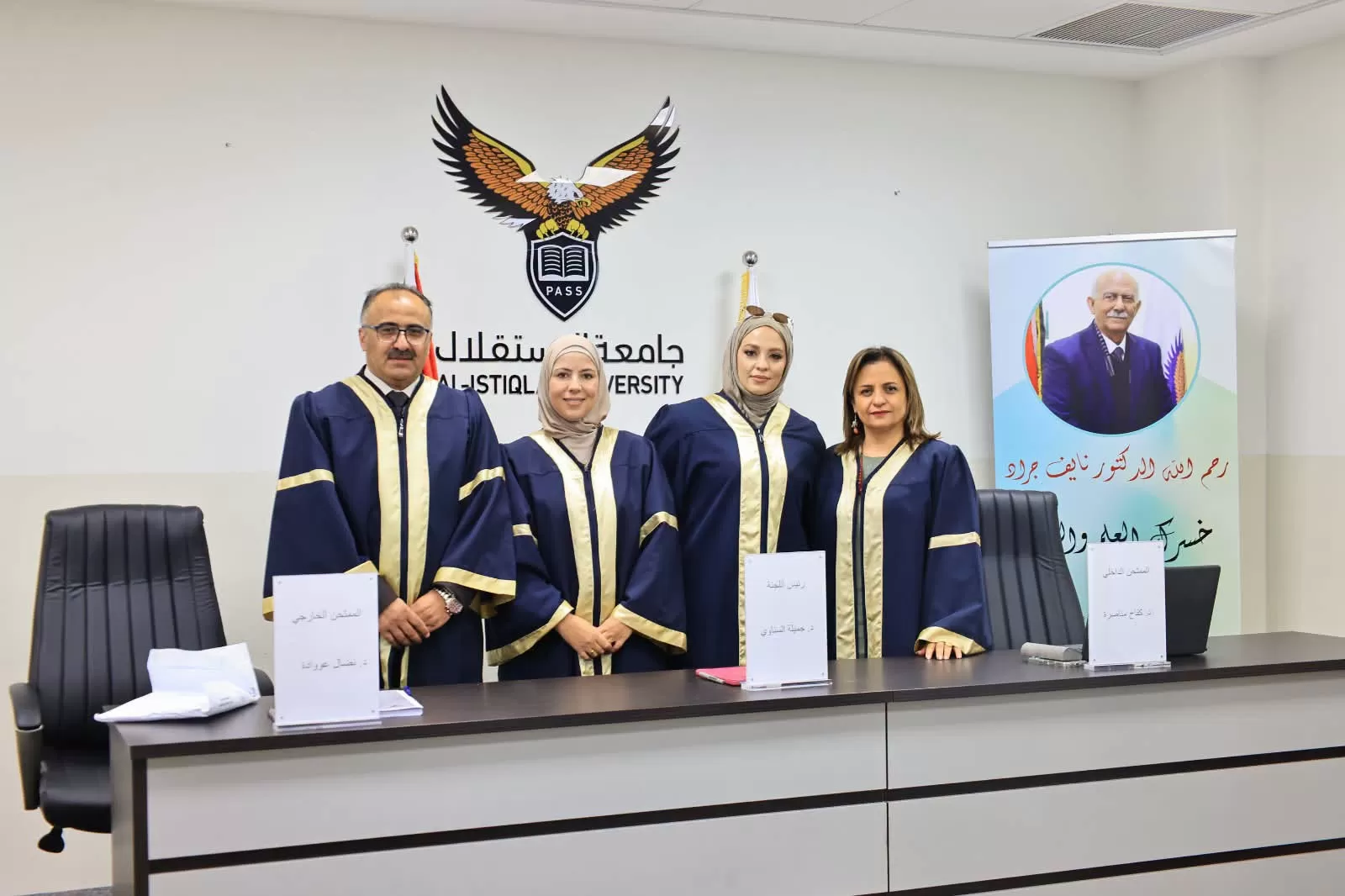
The Faculty of Graduate Studies and Scientific Research at Al-Istiqlal University, through the Department of Criminal Investigation, held the defense of a master’s thesis submitted by student Taima Mohammad Ibrahim, entitled “Invalidity of Search Procedures in Cybercrime Cases under Palestinian Legislation: A Comparative Study.”
The examination committee comprised Dr. Hikmat Amarna, Supervisor; Dr. Ghassan Alian, External Examiner; and Prof. Dr. Issam Al-Atrash, Internal Examiner.
The study sought to examine the legal provisions governing the invalidity of search procedures in cybercrime cases under Palestinian legislation. It also aimed to identify the substantive and procedural safeguards regulating electronic searches, determine the circumstances in which violations of these safeguards render a search invalid, and analyze the legal consequences arising from the invalidity of electronic search procedures. Furthermore, the study drew upon comparative legislation to identify relevant legal approaches and best practices in this field.
The study explained that searches conducted in connection with cybercrime constitute a form of preliminary investigation aimed at obtaining evidence from digital data and information stored on computers and other electronic devices. Such searches are distinguished by their particular nature and sensitivity, given their potential impact on individuals’ rights, freedoms, and privacy. Accordingly, electronic searches are intended to secure digital evidence through legally prescribed measures and safeguards.
The study found that the legislator has established a set of substantive and procedural safeguards governing search operations and protecting accused persons against the arbitrary exercise of authority. Any violation of these safeguards may result in the invalidity of the search. A breach of substantive safeguards gives rise to absolute invalidity, whereas a breach of procedural requirements may result in procedural invalidity.
The study also examined instances of invalidity in electronic searches in light of the theories of statutory invalidity and inherent invalidity. Statutory invalidity requires an explicit legal provision declaring an act or procedure invalid, while inherent invalidity arises when the electronic search procedure fails to achieve the purpose for which it was legally prescribed.
The findings demonstrated that the invalidity of an electronic search procedure entails the exclusion of any evidence obtained through that unlawful procedure. Such evidence may not be relied upon to convict the accused. The effects of invalidity may also extend to preceding or subsequent procedures where these are directly connected to the invalid search. The study further identified several practical and legal challenges affecting the conduct of searches in cybercrime cases.
The study concluded that the substantive and procedural safeguards governing electronic searches are grounded in the principle of legality in criminal proceedings. Violations of these safeguards result in invalidity in accordance with the applicable legal rules, thereby maintaining an appropriate balance between the requirements of combating cybercrime and the protection of individual rights and freedoms.
The researcher recommended organizing specialized training programs for members of the Public Prosecution to strengthen their knowledge and practical capabilities in conducting electronic searches in cybercrime cases. She also recommended establishing specialized university programs and academic disciplines in cybercrime and electronic search procedures, with a view to enhancing the competence of legal and technical professionals working in this field.
At the conclusion of the defense, the examination committee declared the student successful, following confirmation that the thesis had fulfilled the required academic and research standards, subject to the completion of the requested revisions.